
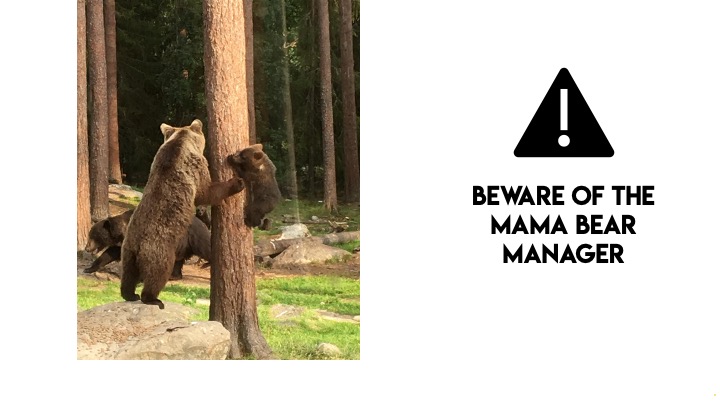
The stereotypical bad boss is an insensitive bully. Word soon gets round about them. Are they a dying breed? You tell me. Harder to spot is another bad boss, the rescuer, or what I call a Mama Bear Manager. These are good people but weak managers.
I coached a Procurement Lead, we’ll call him Kumar, who fell into that trap. He wanted to be the best boss he’d never had himself.
Kumar’s interpretation of a manager’s role was to be a caring head of the family, there to keep everyone stress-free and happy. He felt guilty if anyone said they were feeling a tad overwhelmed. Instead of helping them to prioritise their work, he worked even longer hours and did it for them. He trod the line of least resistance.
Kumar’s own crazy busy line manager was in a different time zone, so she wasn’t much of a role model. The work was getting done: why would she imagine any problems rumbling away under the surface?
The transition from individual contributor to manager can be tricky without proper support. Kumar didn’t even know how much of his time he should spend supporting others. The Chartered Institute of Management estimates that 82% of workers moving into management roles are accidental managers like Kumar. They are figuring it out as they go. That means young people who most need management supervision are working for untrained managers who don’t know how to give it. They see the ‘people stuff’ as a distraction from their real job.
Management surveys often mask people like Kumar. His team gave him adequate scores because they didn’t want to hurt his feelings.
Kumar’s team didn’t need him to backfill for them. They needed him to step up and manage them, to help them develop skills, self-efficacy and confidence. They needed clarity on their priorities. They needed him to spell out the standards expected of them and the purpose behind what they did. They had capability, but Kumar wasn’t building it.
All of this came to light when an alert HR director did some discreet digging and saw some familiar patterns. Kumar’s over-protective style was frustrating high-potential staff who wanted developing, not mollycoddling. His distaste for ‘difficult’ conversations meant Kumar sugar-coated feedback to the point where people had no idea how they could improve. Motivated people moved on to work for better managers. More passive team members simply took advantage of Kumar’s kind nature and continued to moan about the unfairness of everything.
One leaver described working for Kumar as a break at clean motorway services on a long car journey. It was pleasant, but everyone knew they couldn’t stay there long.
This was all fixable. Once we’d removed his blind spots, Kumar stepped up to elevate his team. He gained confidence in giving feedback on the hoof, both positive and corrective. Instead of jumping to provide answers, he asked questions to get people thinking for themselves. They responded by taking greater accountability. He put his nurturing tendencies to better use by advocating internally to get more resources. He spread the work more evenly across his team, even delegating his own workload to free up training time.
I explain the Parent-Adult-Child model I used to shift Kumar in Chapter Seven of Badly Behaved People, my book of case studies like this from my coaching practice.
I’d love to teach your Mama Bear Managers. And your Micro-Managers, your Laissez Faire Managers and your Lone Wolves too.
Save your money
Feedback fuels performance, but 60% of employees say they havent received any useful feedback in the last six months. Don’t waste precious time and money on fluffy training that over-complicates basic skills like this.
My sessions are pragmatic, fluff-free and impactful. Topics like: Crazy Busy (because we could all work smarter) and Giving Your Team the Confidence to Grow will provide a quick uplift in behaviour change. Suitable for workshops, awaydays, and keynotes.
Please DM me to set up a call or email zena@zenaeverett.com